

Buckeye Myrmecology has been granted permits by the USDA which allow us to ship these ants to many states in the Continental US. All shipments of Liometopum apiculatum will include the relevant permit for your state and information on safe handling and disposal of these ants. States that we are allowed to ship Liometopum apiculatum to are listed below.
STATES AVAILABLE FOR SALE: Arizona, Arkansas, Colorado, New Mexico, Oklahoma, Texas, and Utah.
Shipping Notice: Please note that ants are only shipped on Mondays to prevent colonies from being stuck in the mail over the weekend or exposed to poor weather for extensive periods. Orders placed after 12:00 PM EST on Sunday will be shipped one week later on the following Monday. If you are placing an order for UPS Next Day Air Saver and would like us to ship later in the week, please reach out to us via email. Live arrival is guaranteed, if your ants do not arrive in good condition, please take a picture of the ants and contact us within 2 hours of arrival. Please be available to bring your ants inside upon arrival during hot/cold weather, or ask your local post office to hold them for pickup. Shipping times are estimates, and are not guaranteed.
Species Difficulty: Easy, a great beginner species. Care should be taken to maintain escape-proof barriers, as large colonies can be quite adventurous.
Max Colony Size, Growth Speed, and Structure: Liometopum apiculatum forms large colonies with upwards of 250,000 workers at maturity.1 Colonies grow quickly, and can reportedly reach 1000+ workers in a single year, so long as they are provided with plenty of food. This species is sometimes polygynous, with multiple queens per colony.
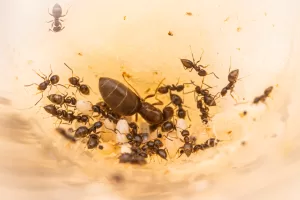
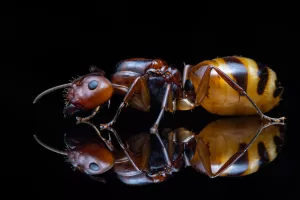
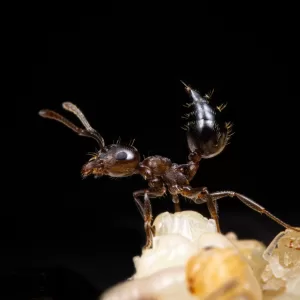
Worker/Queen Sizes and Polymorphism: Liometopum apiculatum workers vary in color from reddish to brownish grey heads/mesosomas, with hairy grey gasters.1 Queens are a brownish grey over their whole body. Workers range from approximately 3 to 6 millimeters in length, while queens can reach more than 15mm long.1,2 This species is not polymorphic, but does have significant size variation within the worker caste.
Hibernation: This species can hibernate, but hibernation is optional and not recommended. To diapause Liometopum apiculatum, cool the colony to ~50-60F. It is important to provide them with a constant water source during diapause, and check on them every few weeks to ensure that they still have water. As they wake up from diapause, colonies will be lethargic, but will not appear to be dead. For more information about diapause, refer to our guide.
Feeding Requirements: Colonies require a constant source of sugars, typically either sugar water or honey. They accept common feeder insects for protein, such as superworms, mealworms, dubia roaches, and fruit flies. Proteins should be fed as often as the ants will accept them, or at least once a week.
Heating and Humidity: Heating will speed up brood development. Brood will prefer high humidity, while workers will prefer medium.
Nesting Habits and Escape Prevention: In the wild, Liometopum apiculatum can be found in a range of habitats throughout the southwest US and Central America. These include oak woodlands, pine forests, desert scrub, and grasslands. Colonies typically nest under rocks or trees, and sometimes form carton nests.2 In captivity, they can thrive in many different nest environments, including acrylic, 3D printed, grout, and ultracal nests. These ants are very good climbers, so only talcum powder or Fluon should be used to prevent escape.
Development Time: Approximately 4-6 weeks egg to worker.
Other notes: In rural areas of Mexico, the larvae of Liometopum apiculatum are harvested as a food called “escamoles.”1
Reviews
There are no reviews yet.